What Is Bacteriostatic Water and Why Is It Used in Peptide Research?
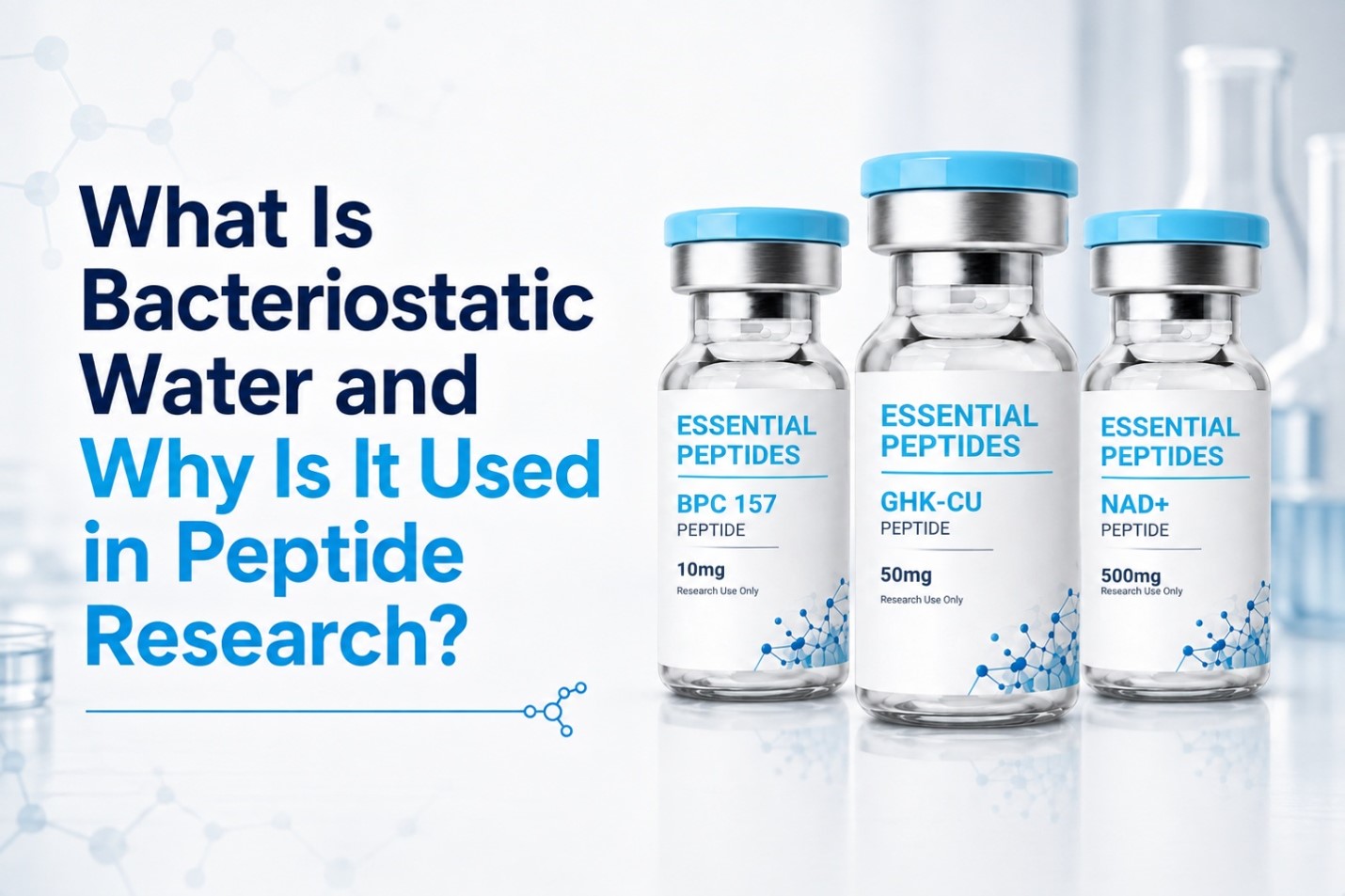
Anyone working withlaboratory research peptides eventually runs into a small but important detail: the liquid used to reconstitute lyophilized compounds matters just as much as the peptide itself. Bacteriostatic water sits at the center of this process, and getting it right affects everything from stability to shelf life. In this blog, we break down what it is, why it matters, and how to handle it correctly in a research setting.
What Is Bacteriostatic Water?
Bacteriostatic water is sterile water that contains a small percentage of benzyl alcohol, typically around 0.9%. Those single additive changes everything about how the water behaves once it’s opened.
Standard sterile water is designed for one use only. Once the seal is broken, it needs to be discarded fairly quickly because nothing in the solution stops bacterial growth. Bacteriostatic water solves that problem. The benzyl alcohol acts as a preservative, slowing microbial growth across multiple uses of the same vial.
For laboratories reconstituting lyophilized peptides, this makes a real practical difference. A single vial can be drawn from repeatedly over several days without the same contamination risk that comes with plain sterile water.
Why Peptide Researchers Rely on It
Peptides in their freeze-dried, powder form are relatively stable when stored correctly. Once they’re mixed with liquid, though, they become far more sensitive to their environment. Temperature, light exposure, and microbial contamination can all degrade the compound faster than expected.
Here’s where bacteriostatic water earns its place in most research workflows:
- Extended usability – A reconstituted vial stays viable for repeated withdrawals over a longer window, rather than needing to be used in a single sitting.
- Reduced contamination risk – The benzyl alcohol content actively works against bacterial growth between uses.
- Consistency across samples – Using the same reconstitution medium each time helps keep experimental conditions uniform, which matters a great deal when comparing results.
- Wide compatibility – It works well with most common research peptide sequences without interfering with their structure.
None of this replaces good laboratory practice. Sterile technique, proper storage, and correct dosing calculations still matter enormously. Bacteriostatic water simply gives researchers a more forgiving margin for error during multi-day use.
How Bacteriostatic Water Differs from Sterile Water
This is a question we get fairly often, and it’s worth clearing up properly.
Sterile water contains no preservative. It’s free of bacteria at the point of sealing, but that protection ends the moment the vial is opened. For single-use applications, that’s fine. For anything involving repeated draws from the same container, it becomes a liability.
Bacteriostatic water, by contrast, is built for exactly that scenario. The benzyl alcohol doesn’t sterilize the solution indefinitely, but it does slow bacterial reproduction enough to make multi-use handling far safer over a reasonable timeframe.
A quick comparison:
- Sterile water – single-use, no preservative, shorter practical window.
- Bacteriostatic water – multi-use, contains benzyl alcohol, longer practical window when stored correctly.
Neither is inherently better in every situation. The right choice depends entirely on how the reconstituted sample will be used.
Proper Storage and Handling
Even with a preservative in the mix, bacteriostatic water still needs to be handled with care. Poor storage habits can undo the benefits fairly quickly.
A few practical guidelines worth following:
- Store opened vials in a refrigerator, ideally between 2°C and 8°C.
- Avoid repeated temperature fluctuations, as they can accelerate degradation.
- Use a fresh needle for each draw to reduce contamination risk.
- Keep the vial away from direct light where possible.
- Discard the solution once it shows any discoloration or cloudiness, regardless of how long it’s been in use.
Most guidance suggests using an opened vial within a defined window, often around four weeks, though this can vary depending on the specific peptide and storage conditions. Checking product-specific documentation is always the safer approach rather than assuming a blanket timeframe applies.
Choosing the Right Supplier Matters
Not all bacteriostatic water is produced to the same standard, which is why sourcing from a reliable research peptide supplier is worth taking seriously. Quality control, correct benzyl alcohol concentration, and proper sterile packaging all affect how well the product performs in practice.
When looking forbacteriostatic water UK sources, a few things are worth checking before ordering:
- Confirm the supplier tests batches for purity and correct concentration.
- Look for clear labeling on benzyl alcohol content and volume.
- Check that packaging is sealed and shipped under appropriate conditions.
- Ask whether documentation or a Certificate of Analysis is available on request.
A dependable peptide company UK researchers can trust will generally be transparent about sourcing, testing, and storage recommendations. That transparency tends to be a fair indicator of overall product reliability across their wider catalog too.
Getting the Reconstitution Ratio Right
Mixing bacteriostatic water with a peptide company UK isn’t a one-size-fits-all process. The ratio used directly affects the final concentration, which in turn affects every calculation that follows.
Adding too much water dilutes the peptide beyond what’s useful. Adding too little makes precise dosing difficult and increases the risk of measurement error. Most researchers work out the correct volume based on the peptide’s total mass and the intended concentration per milliliter, then adjust the water volume accordingly.
Keeping a written record of the ratio used for each vial is a simple habit that pays off. It removes guesswork from future draws and keeps results consistent across a project, particularly when several people are handling the same samples.
Conclusion
Bacteriostatic water might seem like a minor detail compared to the peptides themselves, but it plays a genuinely important role in how research samples behave once reconstituted. Choosing the correct type of water, storing it properly, and sourcing it from a supplier that takes quality seriously all contribute to more reliable results.
At Essential Peptides, we supply bacteriostatic water alongside our wider peptide range, with attention to purity, correct labeling, and proper handling from dispatch through to delivery. Getting these fundamentals right makes a measurable difference to the consistency of research outcomes.
Frequently Asked Questions
1. Can bacteriostatic water be used with any peptide sequence?
Most common research peptides are compatible with bacteriostatic water, though it’s always worth checking specific product guidance, as some sequences may have particular reconstitution requirements.
2. How long does an opened vial of bacteriostatic water typically last?
When refrigerated correctly, an opened vial is generally usable for around 28 days, though this can vary depending on storage conditions and the specific product.
3. Is bacteriostatic water the same as saline solution?
No. Saline solution contains sodium chloride, while bacteriostatic water contains benzyl alcohol as a preservative. They serve different purposes and shouldn’t be used interchangeably without checking compatibility.
4. Why shouldn’t sterile water be reused across multiple draws?
Sterile water lacks a preservative, so once opened, it carries a higher risk of bacterial growth with repeated use, making it unsuitable for multi-day reconstitution in most research settings.