What Are Lyophilised Peptides? A Guide to Freeze-Dried Research Peptides
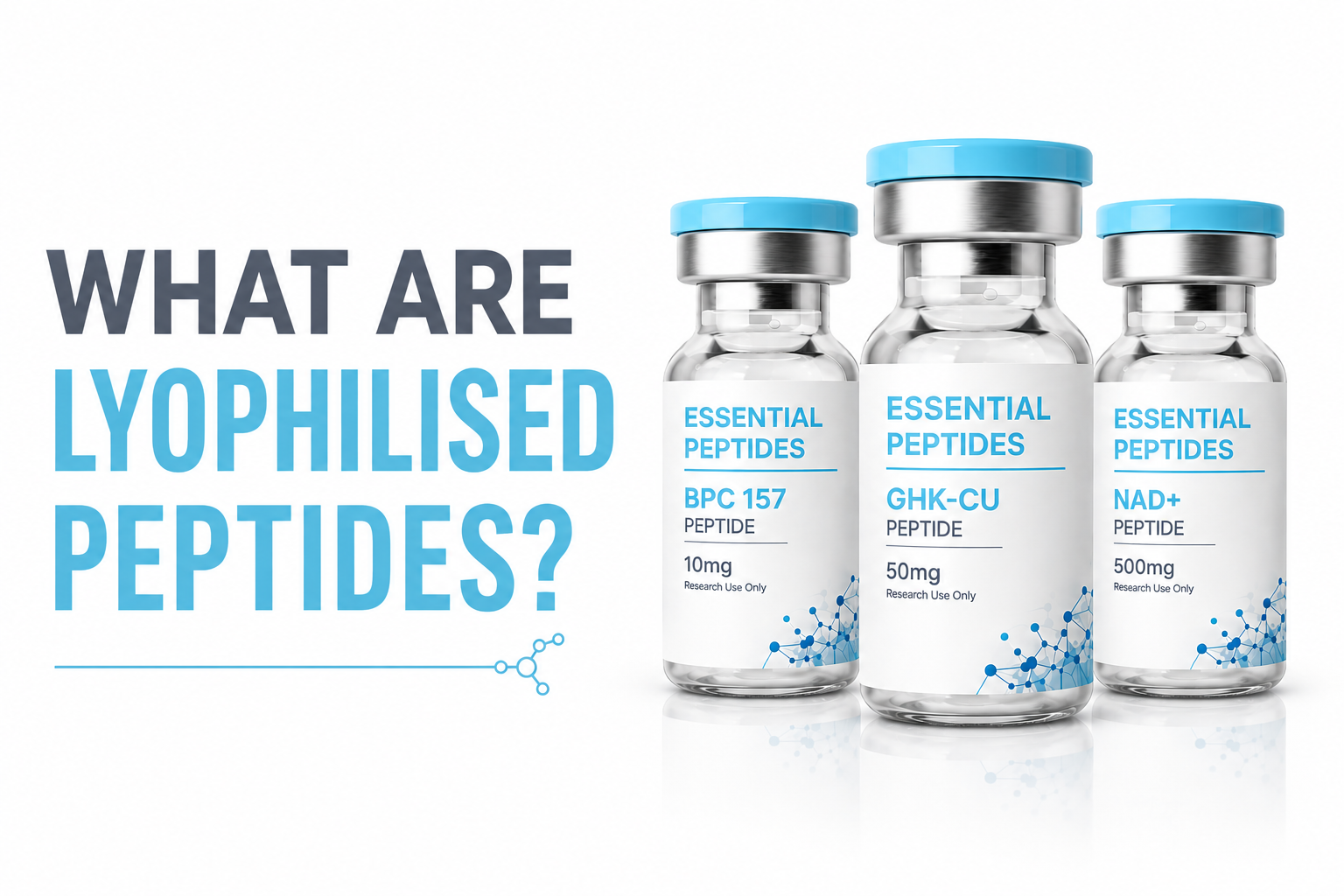
Lyophilised peptides are peptide materials that have undergone a freeze-drying process designed to remove water from the material. Lyophilisation is widely used in laboratory and scientific settings to prepare certain materials for storage, transport and subsequent research applications.
Researchers working with peptide materials may encounter the terms lyophilised, freeze-dried or lyophilized. These generally refer to the same underlying process.
This guide explains what lyophilised peptides are, how the lyophilisation process works and why storage and handling information remains important.
What Does Lyophilised Mean?
Lyophilisation is another term for freeze-drying.
During the process, material is frozen before water is removed under reduced pressure. This allows frozen water to transition primarily from ice to vapour rather than passing through a conventional liquid phase.
The resulting material may appear as a dry powder, cake or residue depending on the product and manufacturing process.
Why Are Research Peptides Lyophilised?
Removing water can make certain materials more suitable for storage and transportation.
For research peptides, lyophilisation may help reduce some degradation processes associated with the presence of water and can provide a convenient physical form for laboratory storage.
However, lyophilisation does not make every peptide indefinitely stable. Individual peptides can have different stability characteristics and storage requirements.
Researchers should therefore always review the information supplied for the particular material being studied.
How Does Peptide Lyophilisation Work?
The exact process can vary, but lyophilisation generally involves three broad stages.
First, the material is frozen under controlled conditions.
During primary drying, pressure is reduced and frozen water is removed through sublimation.
A secondary drying stage may then be used to reduce remaining moisture further.
Parameters such as temperature, pressure and drying time can be controlled according to the characteristics of the material being processed.
What Do Lyophilised Peptides Look Like?
The physical appearance of lyophilised peptides can vary.
Depending on the material and manufacturing process, the contents of a vial may appear as a compact cake, loose powder or thin layer of dried material.
Appearance alone should not be used to determine peptide identity, purity or overall quality.
Analytical testing and appropriate documentation provide more meaningful information when evaluating research materials.
Does Lyophilisation Determine Peptide Purity?
No. Lyophilisation and peptide purity describe different characteristics.
Lyophilisation refers to the process used to remove water from a material, whereas purity relates to the composition of the sample as assessed using an appropriate analytical method.
Techniques such as High-Performance Liquid Chromatography (HPLC) may be used to assess peptide purity, while other analytical techniques can provide information relating to identity.
A freeze-dried appearance therefore does not demonstrate that a peptide has a particular level of purity.
How Should Lyophilised Peptides Be Stored?
Storage requirements depend on the specific peptide and product.
Factors such as temperature, light exposure and moisture may be relevant to the stability of peptide materials. Researchers should follow the product-specific storage information and laboratory documentation supplied with the material.
Appropriate laboratory storage also helps maintain clear identification and batch traceability.
For more information about temperature, light and moisture considerations, read our laboratory guide to peptide storage.
Labelling and Batch Traceability
Clear identification remains important when storing lyophilised peptides.
Labels may contain information such as the peptide name, quantity and batch or lot number. These identifiers can help connect the physical research material with relevant analytical documentation.
Maintaining batch traceability can be particularly useful where Certificates of Analysis or other testing documentation are supplied for individual batches.
Evaluating Lyophilised Research Peptides
Researchers evaluating peptide materials may consider several pieces of information together rather than relying solely on physical appearance.
These can include product identification, stated purity, analytical testing, batch information, storage guidance and supporting documentation.
Reviewing these factors together can provide a clearer understanding of the material being supplied for laboratory research.
Lyophilised Peptides at Essential Peptides
Essential Peptides supplies a range of peptide materials in lyophilised form for laboratory and scientific research.
Our product information is designed to provide researchers with clear identification and relevant specifications, with testing and batch documentation available for applicable products.
Researchers can explore the current range through the Essential Peptides shop.
Research Use Only
Products supplied by Essential Peptides are intended strictly for laboratory and scientific research purposes.
They are not medicines, supplements or food products and are not intended for human consumption or for the diagnosis, treatment or prevention of any medical condition.